Last updated: May 2026 | Data verified against official issuer terms
Disclaimer: We are not financial advisors. The information in this article is for educational purposes only and does not constitute financial advice. Credit card terms, fees, and offers change frequently — always verify current details on the issuer’s official website before applying. This article may contain affiliate links; we may earn a commission if you are approved for a card, at no extra cost to you. Approval is not guaranteed and depends on your creditworthiness.
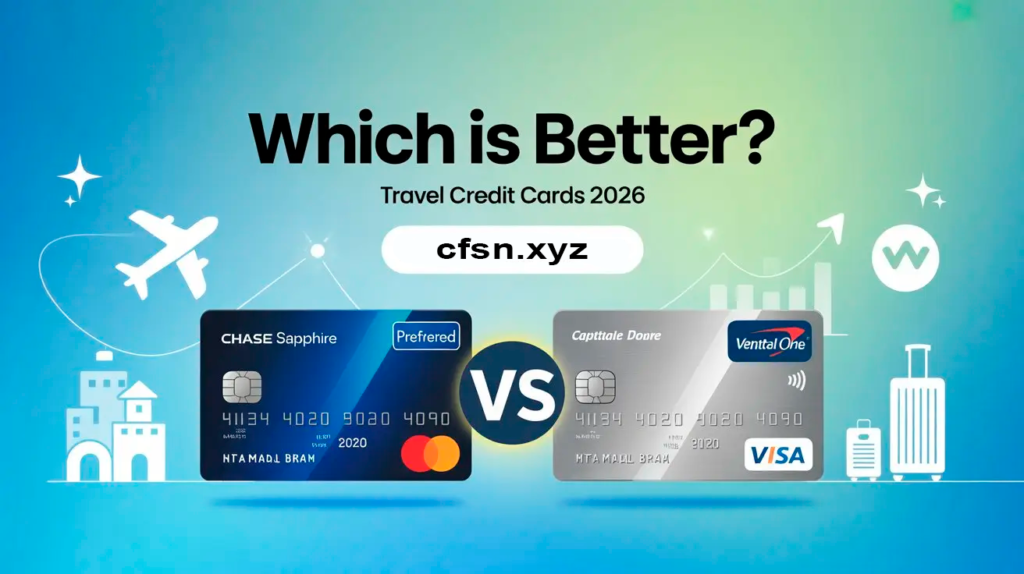
When it comes to mid-range travel credit cards, few matchups are as evenly contested as the Capital One Venture Rewards Credit Card versus the Chase Sapphire Preferred® Card.
Both charge exactly $95 per year. Both currently offer a 75,000-point welcome bonus. Both transfer miles and points to airline and hotel loyalty programs. Both have no foreign transaction fees. And both consistently rank among the most recommended travel cards for anyone who doesn’t want to commit to a $500+ premium annual fee.
They’re not the same card, though. The Venture is built on radical simplicity — a flat 2x on everything, a dead-easy redemption process, and a Global Entry credit that’s rarely seen at this price point. The Sapphire Preferred is built on earning power and strategic flexibility — bonus categories that reward how most people actually spend, superior travel protections, and access to Chase Ultimate Rewards’ transfer partner ecosystem, including the coveted World of Hyatt.
Choosing between them often comes down to one question: Do you want the card that’s easier to use, or the card that rewards you more when you use it strategically?
This guide gives you the complete answer.
Quick Comparison: Capital One Venture vs. Chase Sapphire Preferred
| Feature | Capital One Venture | Chase Sapphire Preferred® |
|---|---|---|
| Annual Fee | $95 | $95 |
| Welcome Bonus | 75,000 miles after $4,000 spend (3 months) | 75,000 points after $5,000 spend (3 months) |
| Base Earning Rate | 2x miles on everything | 1x on most purchases |
| Best Earning Rate (portal) | 5x on hotels, vacation rentals & rental cars (Capital One Travel) | 5x on travel (Chase Travel) |
| Dining | 1x | 3x |
| Online Groceries | 1x | 3x |
| Streaming | 1x | 3x |
| Direct Travel (non-portal) | 2x | 2x |
| Redemption Value (portal) | 1 cent/mile (fixed) | Up to 1.5 cents/point (Points Boost) |
| Transfer Partners | 15+ airline & hotel partners | 14 airline & hotel partners |
| Hyatt Transfer | No | Yes (1:1) |
| Delta Transfer | No | No |
| United Transfer | No | Yes (1:1) |
| Global Entry / TSA PreCheck | Yes (up to $120 every 4 years) | No |
| Annual Hotel Credit | $50 (Lifestyle Collection) | $50 (Chase Travel) |
| Primary Rental Car Insurance | No (secondary) | Yes |
| Trip Cancellation Insurance | No | Up to $10,000/person |
| Trip Delay Coverage | No | After 12 hours |
| Baggage Delay Insurance | No | After 6 hours |
| Foreign Transaction Fees | None | None |
| Authorized User Fee | Free | Free |
| Credit Score Required | Good–Excellent (700+) | Good–Excellent (700+) |
Annual Fee and Welcome Bonus: A Dead Heat on Price, an Edge to Venture on the Bonus
Both cards charge $95 per year, placing them in the most competitive segment of the travel card market — premium enough to offer real rewards, modest enough to justify with minimal effort.
Where they differ is the welcome bonus spending requirement:
- Capital One Venture: 75,000 miles after spending $4,000 in the first 3 months
- Chase Sapphire Preferred: 75,000 points after spending $5,000 in the first 3 months
Same bonus amount. But the Venture requires $1,000 less spending to earn it, which matters for anyone who might struggle to hit a higher minimum spend threshold. At current valuations (approximately 1–1.8 cents per mile/point depending on redemption method), both bonuses are worth $750–$1,350+ in travel value.
Winner: Capital One Venture on the welcome bonus — same reward, lower barrier to earn it.
Earning Rates: The Venture’s Simplicity vs. the Preferred’s Power
This is the most important difference between the two cards, and it comes down to your spending profile.
Capital One Venture: Flat 2x on Everything
The Venture’s earning structure is as simple as it gets:
- 5x miles on hotels, vacation rentals, and rental cars booked through Capital One Travel
- 2x miles on every other purchase, with no categories to track
That 2x on everything is the Venture’s core identity. Whether you’re buying groceries, paying your phone bill, shopping online, or filling up at a gas station, you always earn 2x. There’s no mental overhead, no bonus category calendar to check, and no risk of accidentally spending in the wrong category.
Chase Sapphire Preferred: Bonus Categories That Reward Real Life
The Preferred has a more complex earning structure — but one that’s designed to match how most people actually spend:
- 5x points on travel booked through Chase Travel
- 3x points on dining (restaurants, delivery, takeout worldwide)
- 3x points on online grocery purchases
- 3x points on select streaming services
- 2x points on all other travel purchases (booked directly)
- 1x points on everything else
For people who spend meaningfully on dining and groceries — which is nearly everyone — the Preferred earns significantly more per dollar in those categories. The difference at a restaurant, for example, is 3x Preferred vs. 2x Venture. At 1.5¢/point (Chase Travel Points Boost), that’s 4.5¢ vs. 2¢ per dollar spent.
Who Earns More Overall?
The answer depends on your spending mix. Consider a typical monthly budget of $3,000:
| Category | Monthly Spend | Venture (2x) | Sapphire Preferred |
|---|---|---|---|
| Dining | $500 | 1,000 miles | 1,500 points (3x) |
| Online Groceries | $400 | 800 miles | 1,200 points (3x) |
| Streaming | $100 | 200 miles | 300 points (3x) |
| Travel (direct) | $300 | 600 miles | 600 points (2x) |
| Everything else | $1,700 | 3,400 miles | 1,700 points (1x) |
| Monthly Total | $3,000 | 6,000 miles | 5,300 points |
In this example, the Venture earns more raw units per month — because its flat 2x on the $1,700 “everything else” category far outpaces the Preferred’s 1x. But the Preferred’s points are potentially worth more per unit at redemption (up to 1.5¢ vs. 1¢ through each respective portal), which closes or reverses the gap.
The real-world verdict: If you spend a lot on dining, groceries, and streaming and relatively little on miscellaneous purchases, the Sapphire Preferred earns more valuable rewards. If you spend heavily across many different categories with no clear concentration, the Venture’s flat 2x may be simpler and just as rewarding.
Winner: Tie — depends entirely on your spending mix.
Redemption: Fixed Miles vs. Flexible Points
How you redeem your rewards is where the two cards diverge most significantly.
Capital One Venture: Flexibility Without Complexity
The Venture’s most celebrated redemption feature is its “Purchase Eraser”: you can use miles to cover any travel purchase made within 90 days, at a fixed rate of 1 cent per mile. Book a flight on any airline, any hotel, any rental car company — pay with your Venture card, then request a statement credit for the miles at 1¢ each.
This means 75,000 miles = $750 toward any travel purchase. No portals required, no blackout dates, no award availability issues. Just purchase and reimburse.
You can also book through Capital One Travel for the same 1¢/mile rate, or transfer to airline and hotel partners for potentially higher value.
Chase Sapphire Preferred: Higher Ceiling with Points Boost
Chase Ultimate Rewards points work differently — and in many cases, more lucratively.
When redeeming through Chase Travel with Points Boost, select flights and hotels can yield up to 1.5 cents per point — 50% more than the Venture’s fixed 1¢/mile rate. On 75,000 points, that’s up to $1,125 in travel value through the portal.
The highest value comes from transferring to partners, where points can be worth 2–5¢+ each at premium hotel properties or business class award flights.
Winner: Chase Sapphire Preferred — higher potential redemption value through both the portal (up to 1.5¢) and transfer partners.
Transfer Partners: Capital One Has More, Chase Has Better
Both cards offer access to transferable miles ecosystems — a major advantage over fixed-value travel cards.
Capital One Venture Transfer Partners (15+)
Capital One miles transfer to over 15 airline and hotel partners, including:
Airlines: Air Canada Aeroplan, Avianca LifeMiles, British Airways Avios, Singapore Airlines KrisFlyer, Turkish Airlines Miles&Smiles, Virgin Red, Emirates Skywards, Etihad Guest, Cathay Pacific Asia Miles, Japan Airlines Mileage Bank, Qantas Frequent Flyer, Aeromexico Rewards, TAP Air Portugal Miles&Go
Hotels: Wyndham Rewards, Choice Privileges, Accor Live Limitless
Most airline partners transfer at 1:1, though a few (including Emirates and EVA Air) transfer at less favorable ratios — always check the current rate before transferring.
The best Capital One transfer partners according to consistent analysis are Avianca LifeMiles (strong for Star Alliance award bookings), Air Canada Aeroplan (flexible partner network), and British Airways Avios (valuable for short-haul redemptions and Iberia flights).
Chase Sapphire Preferred Transfer Partners (14)
Chase Ultimate Rewards transfers at 1:1 to all 14 partners, with no unfavorable ratios:
Airlines: United MileagePlus, Southwest Rapid Rewards, British Airways Avios, Air France/KLM Flying Blue, Singapore Airlines KrisFlyer, Iberia Plus, Air Canada Aeroplan, JetBlue TrueBlue, Virgin Atlantic Flying Club, Aer Lingus AerClub, Emirates Skywards
Hotels: World of Hyatt, Marriott Bonvoy, IHG One Rewards
The World of Hyatt transfer is the decisive differentiator. Chase is the only major transferable currency issuer that partners with Hyatt. Category 1–4 Hyatt properties start as low as 3,500–8,000 points per night, and all-inclusive Hyatt resorts regularly deliver 3–5 cents per point in value — among the best redemptions available to any credit card holder.
United MileagePlus is another Chase-exclusive gem for domestic travel: it partners with Aeroplan for non-stop domestic and international redemptions, and United’s expanded partner network allows you to fly on Star Alliance carriers with miles earned from the Preferred.
Capital One does not transfer to Hyatt, United, or Southwest — three of the most commonly used domestic programs in the U.S.
Winner: Chase Sapphire Preferred — fewer partners but better ones for most U.S. travelers, especially with Hyatt, United, and Southwest.
Travel Benefits and Protections: Not Even Close
This is the sharpest difference between the two cards — and it consistently surprises people who assume the Venture offers similar coverage at the same price point.
Capital One Venture Benefits
- Global Entry or TSA PreCheck credit — up to $120 every 4 years (one of the few $95 cards offering this)
- $50 hotel credit at Lifestyle Collection properties (limited selection compared to Chase Travel)
- Hertz Five Star status — free vehicle class upgrades and broader selection at Hertz
- Travel accident insurance
- Secondary rental car coverage (you file first with personal insurance)
- No foreign transaction fees
Chase Sapphire Preferred Benefits
- $50 annual hotel credit via Chase Travel
- 10% anniversary points bonus — each year, bonus points equal to 10% of prior-year purchases
- Complimentary DashPass membership for at least one year (activate by Dec. 31, 2027)
- $10/month DoorDash promo credits on non-restaurant orders (through Dec. 31, 2027)
- Primary rental car insurance — covers the full rental, no personal insurance filing required
- Trip cancellation/interruption insurance — up to $10,000 per person
- Trip delay reimbursement — after 12 hours, up to $500 per ticket
- Baggage delay insurance — after 6 hours, up to $100/day for 5 days
- Lost luggage reimbursement — up to $3,000 per person
- No foreign transaction fees
The Venture’s standout benefit is the Global Entry/TSA PreCheck credit — a $120 value every four years that the Sapphire Preferred does not offer at all. If you don’t have Global Entry yet, applying for the Venture first year and using this credit essentially reduces your effective first-year annual fee to negative territory.
But on travel protections, the Sapphire Preferred is in a different league. Primary rental car insurance alone is worth $20–$40 per rental at most agencies. Trip cancellation coverage up to $10,000 per person can be the difference between a devastating financial loss and full reimbursement if a family emergency forces you to abandon an expensive international trip.
The Venture offers none of these protections. No trip cancellation, no trip delay, no baggage delay, no primary rental car coverage. For a card that markets itself heavily to travelers, this is a notable gap.
Winner: Chase Sapphire Preferred — by a significant margin on travel protections. Capital One Venture wins the Global Entry credit specifically.
The Simplicity Factor: Venture’s Underrated Advantage
We’d be doing the Venture a disservice by not addressing its most compelling quality: it requires almost zero mental energy to use.
With the Sapphire Preferred, maximizing rewards means remembering which purchases earn 3x, booking travel through Chase Travel to earn 5x, knowing when to use points through the portal vs. when to transfer to partners, and understanding the Points Boost feature. It’s not complicated compared to truly complex systems — but it is a layer of management that some people genuinely don’t want.
With the Venture, you swipe the card, earn 2x, and use your miles to erase travel purchases or transfer to a partner when you want more value. There’s nothing to track, nothing to activate, and no categories to memorize.
For travelers who just want a solid flat-rate card that reliably generates travel value without homework, the Venture is one of the best options at any price point.
Can You Have Both Cards?
Yes — and it’s actually a surprisingly effective combination:
- Use the Chase Sapphire Preferred for dining, online groceries, and streaming (3x UR points)
- Use the Capital One Venture for everything else (2x miles, better than the Preferred’s 1x)
Combined annual fee: $190. Combined benefit: maximized earning across all spending categories, two separate welcome bonuses (timing your applications to avoid back-to-back spend requirements), access to both Chase and Capital One transfer partner networks, and the Venture’s Global Entry credit on top of the Preferred’s travel protections.
For travelers who can manage two cards comfortably, this pairing is legitimately excellent.
Who Should Get the Capital One Venture?
The Capital One Venture is the right card if:
- You want a simple, no-category-tracking travel card with solid flat-rate rewards
- You spend heavily across many different categories without a dominant dining or grocery concentration
- You don’t yet have Global Entry or TSA PreCheck and want the credit — a rare benefit at this price point
- You prefer being able to erase any travel purchase as a statement credit without booking through a portal
- You fly airlines in Capital One’s network (especially Avianca, Aeroplan, or British Airways) more than United, Southwest, or Hyatt properties
Who Should Get the Chase Sapphire Preferred?
The Chase Sapphire Preferred is the right card if:
- You spend significantly on dining, groceries, or streaming and want to earn 3x rather than 2x in those categories
- You rent cars regularly and want primary rental car insurance without paying extra
- You value trip cancellation and trip delay coverage for expensive international travel
- You want access to World of Hyatt — the single best hotel transfer in the consumer card space
- You’re willing to do a modest amount of rewards optimization in exchange for higher potential value per point
The Verdict
For most travelers: Chase Sapphire Preferred.
The combination of superior travel protections, higher bonus category earning rates, primary rental car insurance, and access to World of Hyatt gives the Preferred an edge that’s hard to overcome — even against a card with a flat 2x on everything. At the same $95 annual fee, the Preferred delivers more value per dollar for the majority of travelers.
For simplicity seekers and first-time travel card holders: Capital One Venture.
If you want a card you never have to think about, the Venture is one of the best in the business at that job. The flat 2x on everything, dead-simple redemption, and Global Entry credit make it a genuine pleasure to use without any rewards strategy required. For beginners who find the Chase ecosystem overwhelming, or for travelers whose spending doesn’t fit neatly into bonus categories, the Venture is the smarter starting point.
Frequently Asked Questions
Do both cards charge foreign transaction fees? No. Both the Capital One Venture and Chase Sapphire Preferred have no foreign transaction fees, making both excellent choices for international travel.
Which card has a better welcome bonus? Both offer 75,000 miles/points, but the Capital One Venture requires only $4,000 in spending (vs. $5,000 for the Preferred) to earn it. Same reward, lower threshold — a slight edge to Capital One.
Does the Capital One Venture transfer to Hyatt? No. World of Hyatt is exclusively a Chase Ultimate Rewards transfer partner. If Hyatt redemptions are part of your travel strategy, the Sapphire Preferred is the correct card.
Does the Venture card offer trip cancellation insurance? No. The Capital One Venture does not include trip cancellation or interruption insurance. The Chase Sapphire Preferred does, covering up to $10,000 per person per trip.
Which card is better for beginners? The Capital One Venture is generally considered more beginner-friendly due to its flat-rate simplicity. However, the Chase Sapphire Preferred is also frequently recommended for beginners because it introduces the valuable Chase Ultimate Rewards ecosystem, which scales well into more advanced travel strategies over time.
Can I upgrade the Capital One Venture to the Venture X? Yes. Capital One allows product changes between Venture and Venture X. Upgrading to the Venture X ($395/year) adds airport lounge access, a $300 annual travel credit, and a 10,000-mile anniversary bonus — making the effective annual cost nearly zero for regular Capital One Travel users.
Can I upgrade the Chase Sapphire Preferred to the Reserve? Yes, after holding the Preferred for at least 12 months. The Reserve costs $795/year but adds Priority Pass lounge access, a $300 travel credit, enhanced earning rates, and better portal redemption value.
Which has better customer service — Chase or Capital One? Both issuers have strong reputations for customer service. Capital One is frequently praised for its straightforward, no-frills support experience. Chase is known for its extensive branch network and strong digital tools. Neither is meaningfully superior in this area.
Information in this article is based on publicly available data from official issuer websites and financial publications as of May 2026. Capital One transfer ratios to select partners (including Emirates and EVA Air) are not 1:1 — always verify current transfer ratios before transferring miles. This article is for informational purposes only. Always check the card issuer’s official website for current rates, fees, terms, and credit availability before applying.