Last updated: May 2026 | Data verified against official issuer terms
Disclaimer: We are not financial advisors. The information in this article is for educational purposes only and does not constitute financial advice. Credit card terms, fees, and offers change frequently — always verify current details on the issuer’s official website before applying. This article may contain affiliate links; we may earn a commission if you are approved for a card, at no extra cost to you. Approval is not guaranteed and depends on your creditworthiness.
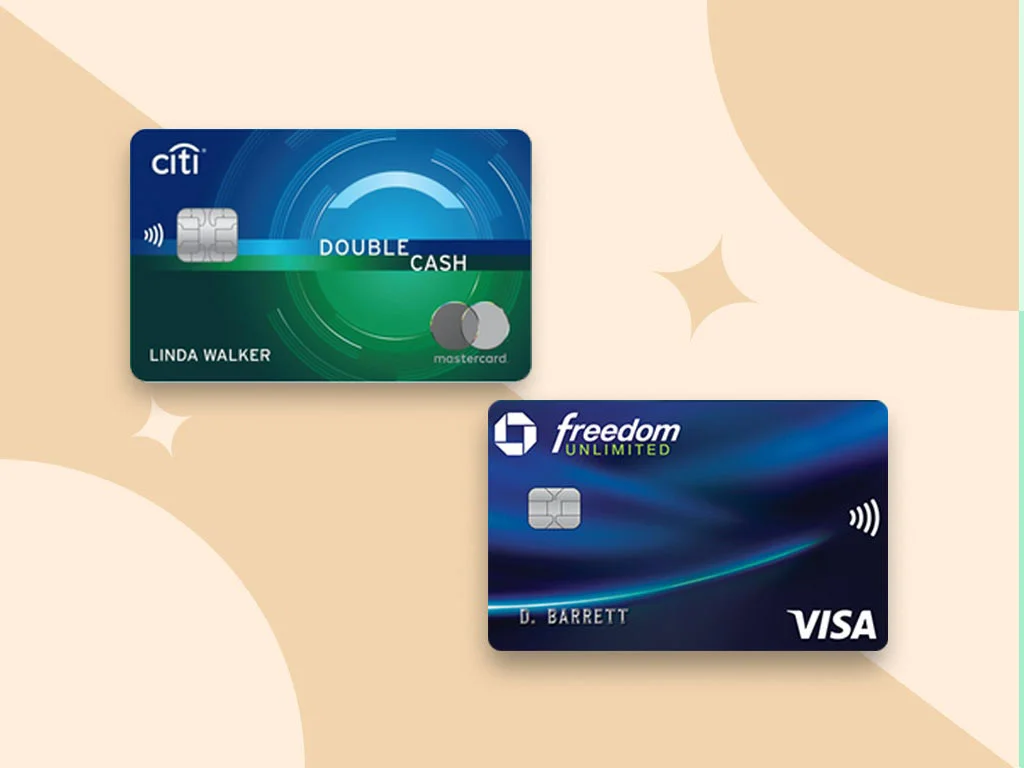
Two of the most popular no-annual-fee cash back cards in America. Two different philosophies about how to earn rewards. And one question millions of cardholders face every year: Citi Double Cash or Chase Freedom Unlimited?
The Citi Double Cash® Card makes its case with elegant simplicity: 2% on every single purchase, no categories, no tracking, no activation. The highest flat rate available on any major no-annual-fee card. For people who want a single card that reliably earns more than average on everything, the Double Cash is a compelling argument.
The Chase Freedom Unlimited® counters with versatility: 3% on dining and drugstores, 5% on Chase Travel bookings, and 1.5% on everything else. A tiered structure that rewards dining-heavy spenders more than any 2% flat card — and integrates into the Chase Ultimate Rewards ecosystem for travelers who want to eventually convert cash back into transferable travel points.
Both cards charge zero annual fee. Both have welcome bonuses. Both earn rewards that can be transferred to airline and hotel partners (with the right companion card). Neither charges a foreign transaction fee… actually wait — both do charge a 3% foreign transaction fee. Keep that in mind.
This comparison breaks down every meaningful difference so you can make the right call for your wallet.
Quick Comparison: Citi Double Cash vs. Chase Freedom Unlimited
| Feature | Citi Double Cash® | Chase Freedom Unlimited® |
|---|---|---|
| Annual Fee | $0 | $0 |
| Base Earning Rate | 2% on everything (1% buy + 1% pay) | 1.5% on everything |
| Dining | 2% | 3% |
| Drugstores | 2% | 3% |
| Chase/Citi Travel Portal | 5% on hotels & rental cars (Citi Travel) | 5% on all Chase Travel (flights, hotels, rentals) |
| Welcome Bonus | $200 after $1,500 spend/6 months | $200 after $500 spend/3 months |
| 0% Intro APR on Purchases | No | Yes (15 months) |
| 0% Intro APR on Balance Transfers | 18 months | 15 months |
| Foreign Transaction Fee | 3% | 3% |
| Ecosystem Partner Card | Citi Strata Premier (unlocks TY transfers) | Chase Sapphire Preferred/Reserve (unlocks UR transfers) |
| Transfer Partners (with pairing) | 17+ airline/hotel partners | 14 airline/hotel partners |
| Hyatt Transfer | No | Yes (with Sapphire card) |
| Delta Transfer | No | No |
| Credit Score Required | Good (670+) | Good (670+) |
Annual Fee: A True Tie
Both cards charge $0 per year — the baseline requirement for cards in this category. Neither one is a hard decision to justify; there’s no annual math to run, no break-even point to calculate. You can keep both cards open indefinitely without any carrying cost.
This makes them excellent long-term credit history builders as well as daily earners. Opening a no-annual-fee card early in your credit journey and keeping it open for years (even if you later move on to premium cards) contributes to your average account age and credit history length — both positive factors for your credit score.
Winner: Tie
Welcome Bonus: Freedom Unlimited by a Significant Margin
Citi Double Cash: $200 cash back after spending $1,500 in the first 6 months Chase Freedom Unlimited: $200 cash back after spending $500 in the first 3 months
Same dollar amount. Radically different spending requirements.
The Freedom Unlimited’s $500 threshold over 3 months — about $167/month in normal spending — is one of the most accessible welcome bonuses of any rewards card, annual fee or not. Most people spend $167/month on groceries alone in their first month with the card.
The Double Cash requires $1,500 over 6 months ($250/month). This is achievable for most households but represents a meaningfully higher bar. For someone applying during a low-spending month, it may require some deliberate effort.
Over the long term, both bonuses are identical in value. But the Freedom Unlimited is simply easier to earn, and it comes with a shorter waiting period before the cash arrives.
Winner: Chase Freedom Unlimited — same bonus, far easier to earn.
Earning Rates: The Core Debate
This is where the comparison gets interesting — and where most comparisons get oversimplified.
Citi Double Cash: 2% on Everything
The Double Cash earns 2% on every purchase — technically split as 1% when you make a purchase and 1% when you pay for it. As long as you pay your balance in full each month (which you should always do on any rewards card), the full 2% arrives without any friction.
There are no categories to remember, no seasonal calendar to check, no minimum spend thresholds in specific areas. Swipe anywhere, earn 2%. That’s the entire model.
Chase Freedom Unlimited: Tiered With a 1.5% Floor
The Freedom Unlimited earns:
- 5% on travel purchased through Chase Travel (flights, hotels, rental cars)
- 3% on dining at restaurants, including takeout and eligible delivery
- 3% on drugstore purchases
- 1.5% on everything else
The 1.5% base rate is lower than the Double Cash’s 2%. But the 3% dining rate is higher than the Double Cash’s 2% on restaurant spending — and dining is one of the largest spending categories for most American households.
The Math for Different Spending Profiles
Scenario 1: Heavy Dining Spender Household spending $600/month on dining, $1,400/month on everything else:
- Citi Double Cash: ($600 + $1,400) × 2% = $40/month
- Chase Freedom Unlimited: ($600 × 3%) + ($1,400 × 1.5%) = $18 + $21 = $39/month
In this scenario, the Double Cash and Freedom Unlimited are nearly tied! The Double Cash wins on non-dining spending ($21 vs. $18/month at 1.5%), while the Freedom Unlimited wins on dining ($18 vs. $12/month at 3%). The overall outcome depends on the exact spending ratio.
Scenario 2: Low Dining, Diverse Spending Household spending $200/month on dining, $1,800/month on everything else:
- Citi Double Cash: $2,000 × 2% = $40/month
- Chase Freedom Unlimited: ($200 × 3%) + ($1,800 × 1.5%) = $6 + $27 = $33/month
Here, the Double Cash wins by $7/month ($84/year) — because the 2% on diverse non-dining spending beats the Freedom Unlimited’s 1.5% floor on a larger portion of spending.
Scenario 3: High Dining, Chase Travel Bookings Household spending $500/month on dining, $300/month on Chase Travel, $1,200/month elsewhere:
- Citi Double Cash: $2,000 × 2% = $40/month
- Chase Freedom Unlimited: ($500 × 3%) + ($300 × 5%) + ($1,200 × 1.5%) = $15 + $15 + $18 = $48/month
The Freedom Unlimited wins here by $8/month ($96/year) — once Chase Travel bookings are factored in, the elevated earning rates push past the Double Cash’s flat advantage.
The practical takeaway: For most households that dine out regularly (3%+ of total spending) and book at least some travel through Chase Travel, the Freedom Unlimited earns more total cash back than the Double Cash. For households with highly diversified spending and minimal dining, the Double Cash’s 2% flat rate is the stronger earner.
Winner: Depends on your spending mix. Freedom Unlimited wins for dining-heavy and Chase Travel users. Double Cash wins for diversified, non-dining-concentrated spending.
0% Intro APR: Different Strengths for Different Needs
Chase Freedom Unlimited: 0% intro APR on both purchases and balance transfers for 15 months (then 18.24%–27.74% Variable APR)
Citi Double Cash: 0% intro APR on balance transfers only for 18 months (no intro APR on new purchases; then 17.49%–27.49% Variable APR)
These offers serve different purposes:
If you need to finance a large new purchase over time (appliance, home repair, medical bill), the Freedom Unlimited’s 15-month 0% on purchases is the tool you need. The Double Cash offers no promotional rate on new purchases — charges start accruing immediately.
If you need to pay off existing high-interest debt from another card, the Double Cash’s 18-month balance transfer window is longer than the Freedom Unlimited’s 15 months. An extra 3 months of interest-free paydown can represent significant savings on larger balances.
Winner: Chase Freedom Unlimited for new purchase financing. Citi Double Cash for longer balance transfer windows.
Transfer Partners: The Strategic Value of Each Ecosystem
Both cards can function as travel point cards — not just cash back cards — when paired with the right companion card. This is where the long-term strategic value of each choice becomes clear.
Citi Double Cash + Citi Strata Premier
The Double Cash earns rewards as Citi ThankYou Points. Standalone, they’re worth 1 cent each as cash back. But paired with the Citi Strata Premier ($95/year), those points become fully transferable to 17 airline and hotel partners, including:
- Turkish Airlines Miles&Smiles
- Avianca LifeMiles
- Air France/KLM Flying Blue
- Singapore Airlines KrisFlyer
- Virgin Atlantic Flying Club
Turkish Miles&Smiles and Avianca LifeMiles in particular are well-regarded for Star Alliance premium cabin award bookings at competitive mileage rates.
Chase Freedom Unlimited + Chase Sapphire Preferred or Reserve
The Freedom Unlimited earns rewards as Chase Ultimate Rewards points. Standalone, they’re worth 1 cent each as cash back. But paired with the Chase Sapphire Preferred ($95/year) or Sapphire Reserve ($795/year), those points become transferable to 14 airline and hotel partners, including:
- World of Hyatt (the most valuable hotel transfer in consumer credit cards)
- United MileagePlus
- Southwest Rapid Rewards
- British Airways Avios
- Air France/KLM Flying Blue
The Hyatt transfer is the decisive differentiator. No Citi card transfers to Hyatt. For travelers who redeem points at Hyatt properties — which consistently deliver 3–5 cents per point in value — the Chase ecosystem’s superiority is hard to overcome.
Winner: Chase Freedom Unlimited for access to Hyatt and the broader Chase travel ecosystem. Citi Double Cash for Turkish Miles&Smiles and Avianca LifeMiles fans.
Important: Both Cards Charge Foreign Transaction Fees
One frequently overlooked limitation both cards share: 3% foreign transaction fees.
Neither the Citi Double Cash nor the Chase Freedom Unlimited is suitable for international use. Any purchase processed outside the United States — whether abroad or at an international online merchant — triggers a 3% surcharge that erases most or all of the rewards earned.
For international spending, use a no-foreign-fee card instead: the Wells Fargo Autograph (no annual fee, no FTF, 3x dining/travel/gas), the Capital One Savor (no annual fee, no FTF, 3x dining), or a premium travel card.
Protections and Benefits
Neither card is a premium travel product, so the protections are more limited than Sapphire-tier cards — but worth knowing.
Chase Freedom Unlimited:
- Purchase protection (120 days, up to $500/item)
- Extended warranty protection (+1 year on manufacturer warranties)
- Trip cancellation/interruption insurance (yes — a notable benefit for a no-fee card)
- Travel and emergency assistance services
Citi Double Cash:
- Citi Entertainment access (presale tickets, events)
- Citi Identity Theft Solutions
- Mastercard ID Theft Protection
- No standout travel protections
The Freedom Unlimited’s inclusion of trip cancellation insurance on a no-annual-fee card is genuinely unusual and valuable — particularly for cardholders who book travel on the card and want some protection against non-refundable cancellations.
Winner: Chase Freedom Unlimited on protections.
The “Which Ecosystem” Decision
Choosing between these two cards is partly a decision about which credit card ecosystem you want to build within.
Choose Citi Double Cash if:
- You prefer the simplest possible rewards structure (2% everywhere, no thinking required)
- You spend across many categories without a concentration in dining
- You need the longest balance transfer window (18 months)
- You’re building toward Citi ThankYou transfer partners, particularly Turkish Miles&Smiles or Avianca LifeMiles
- You spend heavily at international merchants… wait, don’t — both charge 3% FTF
Choose Chase Freedom Unlimited if:
- You eat out regularly (3%+ is meaningfully better on dining)
- You book travel through Chase Travel or plan to
- You want the easiest welcome bonus to earn ($500 threshold, not $1,500)
- You need 0% interest on new purchases for 15 months
- You’re building toward Chase Ultimate Rewards for Hyatt and United transfers
- You want trip cancellation insurance on a no-fee card
Can You Have Both?
Yes — and many cardholders do. The combination creates complementary strengths:
- Double Cash handles all non-dining, non-drugstore spending at 2% (beating Freedom Unlimited’s 1.5% floor)
- Freedom Unlimited handles dining (3%) and any Chase Travel bookings (5%)
If you hold a Sapphire card, you can combine the Freedom Unlimited’s points with your Sapphire for Hyatt access. If you hold a Citi Strata Premier, you can combine the Double Cash’s points for ThankYou airline transfers.
Holding both cards requires managing two issuers’ statements, but both have no annual fee — so the cost is zero. Whether the extra complexity is worth it depends on how seriously you want to optimize rewards.
The Verdict
For most people: Chase Freedom Unlimited.
The combination of a lower welcome bonus threshold ($500 vs. $1,500), meaningful 3% dining rewards, 15 months of 0% APR on purchases, trip cancellation insurance, and access to the Chase ecosystem (including Hyatt via a Sapphire card) gives the Freedom Unlimited a clear edge for the majority of cardholders who dine out regularly and want a card with long-term strategic value.
For pure simplicity and diversified spending: Citi Double Cash.
If you genuinely want zero category tracking, consistently earn 2% on every purchase regardless of what you’re buying, and prefer Citi’s transfer partner ecosystem (particularly Turkish Airlines), the Double Cash is the cleaner solution. For households whose spending doesn’t heavily concentrate in dining, it often earns more total cash back than the Freedom Unlimited year over year.
Frequently Asked Questions
Does the Citi Double Cash have foreign transaction fees? Yes — 3% on each transaction. Neither the Citi Double Cash nor the Chase Freedom Unlimited is suitable for international travel. Use a dedicated no-FTF card for purchases outside the United States.
Can I transfer Citi Double Cash rewards to airlines? Only if you pair the Double Cash with the Citi Strata Premier ($95/year) or another premium Citi ThankYou Points card. Standalone, Double Cash rewards redeem for cash back at 1 cent per point.
Can I transfer Chase Freedom Unlimited rewards to Hyatt? Only if paired with a Chase Sapphire Preferred or Sapphire Reserve. Standalone, Freedom Unlimited rewards redeem for cash back at 1 cent per point.
Which card is better for balance transfers? The Citi Double Cash offers a longer 0% intro period on balance transfers: 18 months vs. 15 months on the Freedom Unlimited. If paying off existing credit card debt is your priority, the Double Cash provides more time.
Which card is better if I never travel? For pure cash back with no interest in travel points, the Citi Double Cash’s 2% flat rate often generates more annual rewards than the Freedom Unlimited for households without heavy dining concentration.
Is the 1% + 1% on the Double Cash actually 2%? Yes — as long as you pay your bill on time. You earn 1% when you make the purchase and another 1% when you pay. If you always pay in full (which you should), the effective rate is 2% with no complications.
Does the Freedom Unlimited earn 3% at all restaurants or just U.S. ones? The 3% on dining applies to eligible restaurants, takeout, and delivery services broadly. However, because the Freedom Unlimited charges a 3% foreign transaction fee, using it at foreign restaurants would cost you 3% FTF and effectively eliminate the 3% dining bonus. For international dining, use a no-FTF card.
Information in this article is based on publicly available data from official issuer websites and financial publications as of May 2026. Credit card terms, welcome bonus offers, and earning categories are subject to change. Always verify current terms at the issuer’s official website before applying. This article is for informational purposes only.